
Hong kong, 26th December 2025, ZEX PR WIRE, As Web3 gaming continues to recalibrate after years of incentive-heavy experimentation, a smaller group of projects is beginning to stand out. Tatakai, as an open-world Web3 RPG, has gained increasing attention by making progress across multiple areas that rarely align at the same time: credible capital backing, real gameplay development, and visible on-chain engagement.
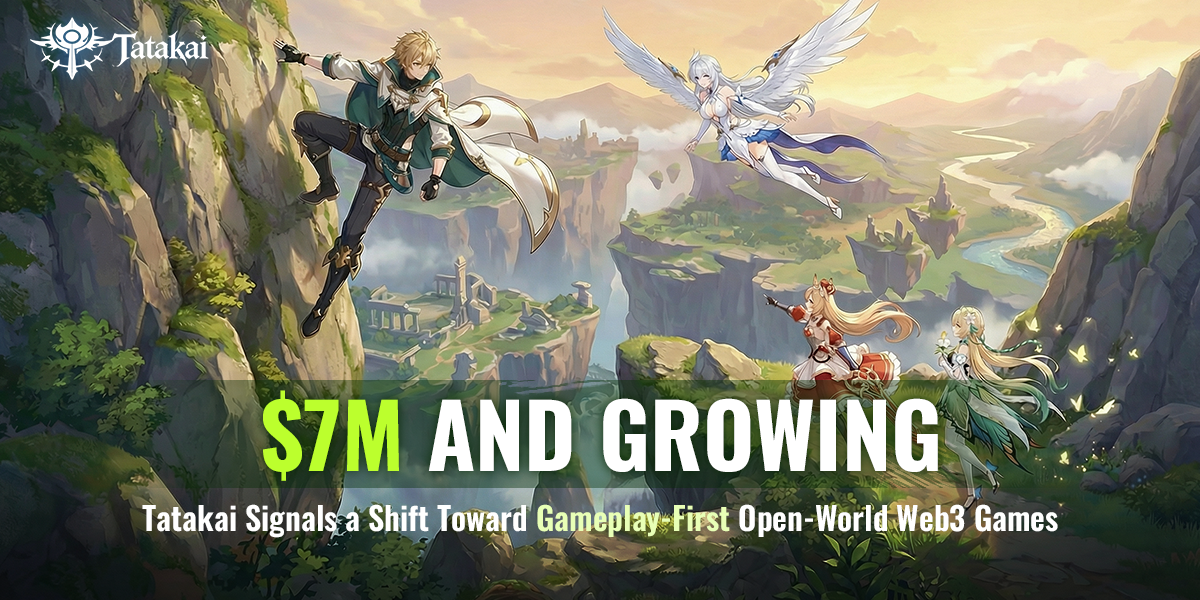
Taken together, these signals position Tatakai not as a short-term experiment, but as a game-led ecosystem built around player experience and sustainable ownership.
Strategic Capital Backs a Gameplay-First Vision
Tatakai’s recently closed $7 million angel round marks a strong vote of confidence from both traditional gaming and Web3-native investors. Participants such as Tencent, YGG (Yield Guild Games), and Immutable represent a mix of established gaming players and blockchain specialists, united by a shared belief in Tatakai’s approach: pairing open-world depth with practical on-chain ownership.
This funding is focused on execution rather than hype. Capital will be directed toward expanding core gameplay systems, strengthening NFT and blockchain infrastructure, and supporting community-driven initiatives such as early access and governance previews. The investor profile reflects a broader shift in the market—projects that prioritize immersion, retention, and long-term play are increasingly favored over token-first designs.
Open-World Design Grounded in Practical Utility
At its core, Tatakai is built as a game first. Players explore large environments, assemble squads of hero NFTs, and engage in turn-based combat that rewards planning and progression. Blockchain elements function as supporting infrastructure rather than the main attraction.
Recent updates show steady refinement of exploration, crafting, progression systems, and seamless in-game trading, many shaped directly by community feedback. This iterative process reflects a clear design philosophy: ownership should enhance gameplay, not replace it. By anchoring Web3 mechanics to real player actions, Tatakai demonstrates a more grounded and playable interpretation of “play-to-own.”
On-Chain Activity Signals Organic Engagement
Tatakai’s early on-chain performance adds another layer of validation. During its beta soft launch on BNB Chain, daily active users increased by roughly 250% week-over-week, alongside rising transaction volume tied to gameplay actions such as squad battles, quests, exploration rewards, and asset upgrades within AI-generated worlds.
Crucially, this activity is driven by play, not short-term incentives. NFT interactions and contract usage are visible on public trackers like DappBay, and ongoing community feedback continues to influence development priorities. For investors and observers, this combination of transparent data and sustained usage points to organic traction rather than manufactured growth.
Tatakai Shows Where Web3 Gaming Is Heading
Tatakai’s progress reflects a wider shift across the industry. As speculative mechanics lose their pull, projects centered on gameplay quality, world depth, and credible ownership are gaining momentum. Tatakai shows how thoughtful design, strategic funding, and real on-chain usage can come together into a more durable model.
At the same time, the technical foundations built for Tatakai have led to the development of Tatakai Protocol, a separate infrastructure layer. Designed from the needs of a live game, the protocol supports AI-driven economies, seamless in-game trading, and scalable on-chain settlement for other Web3 games.
Tatakai remains the player-facing experience at the center, while Tatakai Protocol extends those learnings outward. Together, they point toward a maturing phase of Web3 gaming—where strong games lead, and infrastructure follows to support sustainable growth.
Disclaimer: The views, suggestions, and opinions expressed here are the sole responsibility of the experts. No Daily Insight 360 journalist was involved in the writing and production of this article.